








Joint Commission surveys are an important part of ensuring hospitals maintain high standards for patient safety and quality. For healthcare leaders, they also require being able to demonstrate that staff have the education, training, and competencies needed to perform their roles safely.
With the introduction of Accreditation 360 and the new National Performance Goals in 2026, The Joint Commission has significantly streamlined how its requirements are organized. More than 700 requirements have been removed from the hospital accreditation program, while existing requirements have been reorganized into 14 National Performance Goals designed to create greater clarity around critical areas of safety and quality.
While the structure is new, the National Performance Goals largely reorganize and elevate existing requirements rather than creating an entirely new set of expectations.
For organizations using Dossier, many of these expectations are closely connected to something they are already working on every day: ensuring that employees are prepared and competent to perform the work assigned to them.
Competency Takes a More Prominent Role
National Performance Goal 12, Health Professional Resource Management, is particularly relevant to competency management.
The goal addresses how healthcare organizations plan and evaluate their workforce and includes requirements to verify that employees meet requirements for employment and scope of practice, provide education and training, and evaluate staff competence.
This creates an important question for healthcare organizations:
Can we demonstrate that this employee is prepared and competent to perform the work we are asking them to do?
Answering that question requires more than confirming that an employee has completed an online course or signed a competency checklist.
Recent survey findings show why. Ongoing competency findings have included missing or overdue competency assessments and insufficient validation for specialized or high-risk activities. Initial competency findings have similarly included missing documentation, incomplete competency validation, and employees performing technical processes without evidence that competency had been established.
Competency Is More Than a Checklist
Checklists are an important part of competency management. They help define expectations, provide consistency, and document progress.
But completing a checklist is not necessarily the same as demonstrating competency.
Healthcare professionals develop competency through a combination of education, observation, practice, assessment, and validation. The process should help determine not only whether an employee has been exposed to a skill, but whether that employee can perform the skill appropriately in practice.
This becomes especially important in healthcare, where competencies vary significantly across roles, specialties, departments, patient populations, and levels of experience.
A new graduate nurse beginning orientation has very different competency needs from an experienced ICU nurse. A nurse moving to oncology may require competencies specific to that patient population. Employees working with new equipment or performing specialized procedures may require additional education and validation.
A strong competency program therefore needs to reflect the work employees actually perform.
Using TSAM® to Develop and Validate Competency
One framework many Dossier customers use to manage this progression is the Tiered Skills Acquisition Model, or TSAM®.
TSAM® is an evidence-based framework developed by Mayo Clinic that guides nurses through a tiered progression of skills. Rather than presenting a new nurse with a large collection of skills to complete during orientation, competencies are organized from simple to increasingly complex. The Preceptee demonstrates competence within one tier before progressing to the next, while the Preceptor continues to observe and validate performance.
For example, during the first tier of an orientation, a nurse may be responsible for performing vital signs, intake and output, and related documentation for a complete patient assignment. The Preceptor continues to perform the other interventions required for those patients.
Once those competencies have been demonstrated, the nurse moves to the next tier. Skills learned previously remain part of the assignment while new and more complex competencies are added.
This approach allows competency to develop progressively rather than simply documenting completion of individual tasks.
TSAM® also recognizes that competency requirements are not identical for every nurse. The model includes three levels of competencies:
- Core competencies provide the foundation expected across a broader group of nurses.
- Specialty competencies reflect the specific patient population or clinical environment, such as oncology.
- Individual competencies address additional requirements that may apply to particular nurses or units.
Together, these components provide a structured way to prepare clinicians for the responsibilities they will actually perform.
Bringing TSAM® Into the Daily Workflow
Dossier is an official partner of Mayo Clinic, enabling healthcare organizations to use TSAM® directly within the Dossier platform.
Rather than treating TSAM® as a separate methodology that organizations then have to translate into spreadsheets, paper forms, or another system, the framework can be fully embedded into the same digital environment used to manage competency development.
This gives organizations access to the TSAM® framework while also providing the infrastructure to assign competencies, follow progression through the tiers, document Preceptor validation, and maintain visibility into each clinician’s development.
For organizations adopting TSAM®, this can significantly simplify implementation. The framework and the technology supporting it work together, allowing clinical educators and Preceptors to focus more on developing clinicians and less on creating and maintaining the administrative structure around the program.
Connecting Competency Development and Survey Readiness
The distinction between completing competency requirements and demonstrating competency is important when preparing for a Joint Commission survey.
Survey findings related to ongoing education illustrate this challenge. Organizations have been cited when they could not produce evidence of education or competency validation for employees using specialized equipment, or when training was not aligned with manufacturers’ instructions or organizational requirements.
A healthcare organization therefore needs to be able to demonstrate several things:
- What competencies are required for a particular role or responsibility
- How those competencies were developed and assessed
- Who validated the competency
- Whether the competency remains current
- Which employees have gaps that still need to be addressed
This is where digital competency management can make a significant difference.
How Dossier Supports Joint Commission Readiness
Dossier provides healthcare organizations with a centralized platform for managing competency development, validation, and documentation.
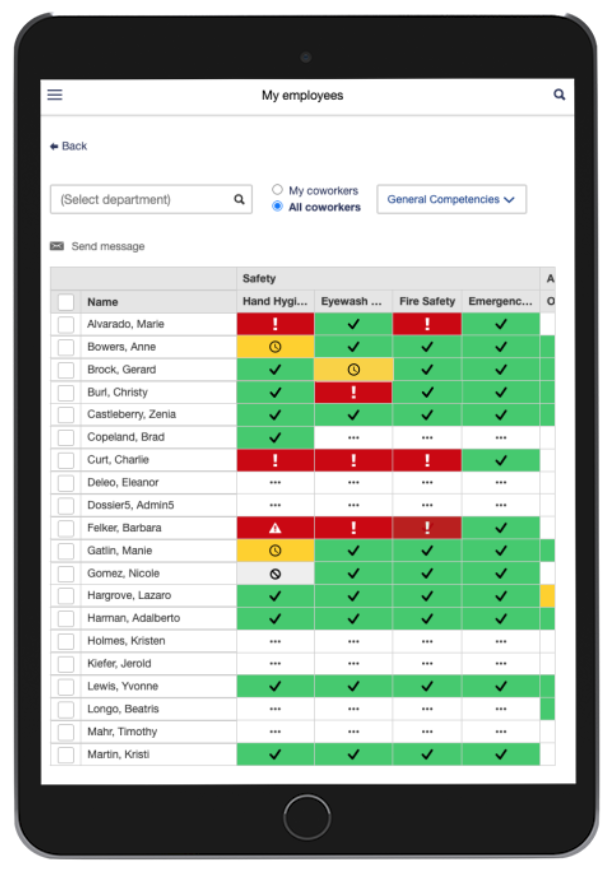
Rather than keeping competency information in spreadsheets, paper files, shared drives, and separate departmental systems, organizations can maintain competency information in one place and gain real-time visibility into workforce readiness.
With Dossier, healthcare organizations can:
- Create role-specific competency plans: Competencies can be structured around roles, specialties, departments, equipment, procedures, and other organizational requirements.
- Use established competency frameworks such as TSAM®: Through Dossier’s official partnership with Mayo Clinic, customers can access TSAM® fully embedded within the Dossier platform and use the framework to support structured nursing orientation and competency development.
- Support progressive competency development: Employees can progress from foundational to increasingly complex skills, while Preceptors and other qualified validators document demonstrated competency along the way.
- Document competency validation: Organizations can record not only that an activity was completed, but also the validation process and the individuals responsible for assessing competency.
- Manage initial and ongoing competency: Competency can be managed throughout the employee lifecycle, from orientation through annual requirements, new responsibilities, new equipment, and changes in role.
- Identify gaps in real time: Managers and educators can see where competencies are incomplete or overdue and address gaps before they become a survey finding.
- Provide accessible evidence: During surveys and audits, competency records are readily available rather than being collected from multiple systems and departments.
This supports the expectations within NPG 12 while also helping organizations strengthen their overall approach to workforce readiness.
Competency Supports More Than NPG 12
Although NPG 12 has the most direct connection to workforce competency, staff knowledge and competence can influence many other areas evaluated during Joint Commission surveys.
Recent survey observations include findings associated with infection prevention, nurses following policies and procedures, medication administration, emergency equipment, suicide risk, and other aspects of clinical practice.
Competency management alone does not satisfy these standards. Hospitals still need the appropriate policies, clinical processes, leadership, and systems in place.
However, an important part of many of these processes is ensuring that the employees responsible for carrying them out understand what is expected and have demonstrated that they can perform the work correctly.
This is why competency management should not be viewed simply as an HR or education activity. It is an important part of patient safety, quality, and organizational readiness.
Moving From Survey Preparation to Continuous Readiness
Traditionally, preparing for a Joint Commission survey can involve considerable effort to locate competency documentation, identify missing records, and follow up with departments before surveyors arrive.
Digital competency management provides an opportunity to move away from this periodic approach.
When competency information is continuously updated and visible, leaders do not have to wait for survey preparation to discover gaps. Managers can see which employees are current, educators can identify areas requiring attention, and employees have greater clarity around what is expected of them.
Frameworks such as TSAM® add another dimension to this. Rather than focusing primarily on whether required activities have been completed, they provide a structured approach for developing clinicians toward demonstrated independent practice.
With TSAM® embedded directly into Dossier, organizations can combine the clinical methodology for developing competency with the technology needed to manage, validate, and monitor that development across a larger workforce.
For healthcare organizations, the objective should ultimately be bigger than preparing documentation for the next survey.
It should be ensuring that employees are competent and prepared to provide safe, high-quality care every day.
Conclusion
The new Joint Commission standards provide healthcare organizations with a more streamlined framework for accreditation, while maintaining a strong focus on workforce competency, patient safety, and quality.
NPG 12 reinforces the importance of education, training, and competency evaluation. Meeting that expectation requires more than completing checklists. Organizations need processes that support competency development, provide appropriate validation, and make workforce readiness visible.
TSAM® provides a structured approach for developing nursing competencies from simple to complex. And through Dossier’s official partnership with Mayo Clinic, healthcare organizations can access TSAM® fully embedded within Dossier rather than having to build the framework into their competency processes themselves.
Dossier brings competency plans, structured development, assessment, validation, and reporting together in one platform—helping organizations maintain continuous readiness while keeping the ultimate focus where it belongs: preparing healthcare professionals to deliver safe and effective patient care.
Want to learn how your organization can use Dossier and the TSAM® framework to strengthen competency development and Joint Commission readiness? Schedule a demo with Dossier.