

Whether you’re training a new grad nurse or preparing for your next audit, one reality is clear: managing workforce competency has never been more complex. Teams are stretched thin, care settings are shifting, and the stakes for compliance and care quality continue to climb.
For organizations pursuing or maintaining Magnet® designation, robust competency programs are essential to demonstrating excellence in nursing practice, continuous improvement, and professional development. Similarly, for those who struggled with their last Joint Commission audit, a digital-first approach to competency management can close documentation gaps, reduce risk, and simplify audit preparation.
This article breaks down the top five competency challenges hospitals face today, and offers proven, technology-enabled solutions to help healthcare leaders stay one step ahead.
Challenge 1: Skill Gaps from High Turnover and Rapid Onboarding
What’s Happening: What’s Happening: According to the American Nurses Association, the United States will need more than 275,000 additional nurses by 2030 to meet demand. Hospitals are onboarding new staff quickly—often with limited experience and varying training backgrounds. Meanwhile, experienced staff are retiring or exiting the workforce, taking institutional knowledge with them.
How to Solve It:
- Use AI-driven learning pathways to personalize onboarding and reinforce critical skills faster.
- Implement digital platforms with pre-built clinical checklists and pathways to reduce variability and standardize training.
- Enable peer-to-peer learning by capturing expertise from experienced staff before they exit.
Challenge 2: Disconnected Systems That Undermine Compliance
What’s Happening: When training tools, HRIS platforms, and EHRs don’t talk to each other, tracking staff competencies becomes a manual and error-prone process. Incomplete or missing records can put compliance—and your accreditation—at risk.
How to Solve It:
- Adopt a centralized digital competency platform that integrates with HR and clinical systems (e.g., Workday, Oracle, Epic).
- Leverage automated reminders for expiring credentials and required modules.
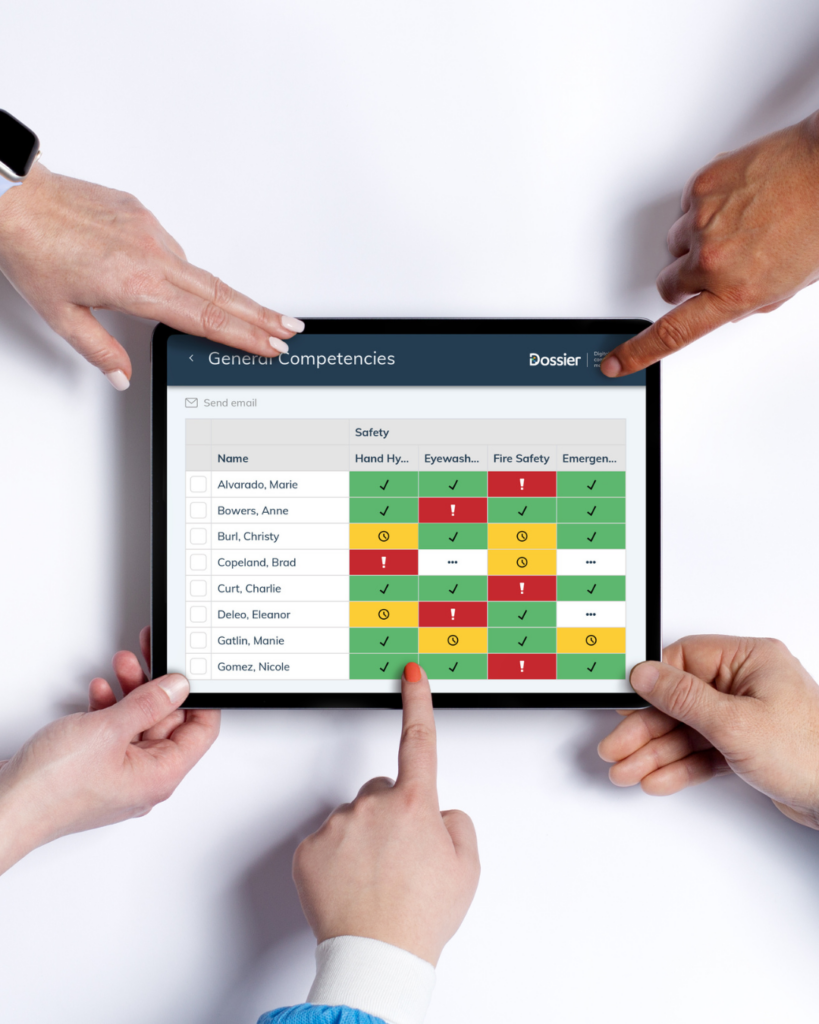
- Ensure real-time dashboards are available for both educators and executive leadership to track readiness and gaps.
Challenge 3: Limited Visibility into Competency Readiness
What’s Happening: Nurse leaders and department heads often lack access to real data about who is truly competency-validated and ready to care for patients. This creates risk when audits or crises arise.
How to Solve It:
- Use predictive analytics to find gaps before they become compliance failures.
- Deploy competency heatmaps to visualize readiness across teams or units.
- Equip educators with real-time cohort tracking tools to prioritize follow-ups and interventions.
Challenge 4: Burnout and Lack of Professional Development
What’s Happening: Manual processes and paper documentation drain educators’ time and lead to staff burnout. Without clear pathways for growth, engagement and retention suffer.
How to Solve It:
- Digitize documentation and checklists to reclaim hours for clinical care.
- Provide career advancement planning and clinical laddering tools that support long-term development.
- Show growth pathways and mentorship programs to boost morale and reduce turnover.
Challenge 5: Adapting to New Care Models (Telehealth, DEI, Cross-Training)
What’s Happening: As care moves beyond the bedside—into homes, virtual visits, and diverse communities—new competencies are needed. Traditional systems can’t keep up with the pace of change.
How to Solve It:
- Deploy telehealth-focused training modules and track staff readiness for virtual care.
- Offer DEI-aligned competencies such as cultural sensitivity and implicit bias training.
- Enable rapid rollout of cross-training content across departments to support flexible staffing models.
Conclusion: Building a Future-Ready Workforce
Healthcare leaders can no longer rely on outdated systems to manage a rapidly evolving workforce. To support Magnet journeys, pass audits with confidence, and retain top talent, hospitals must modernize competency management now.
Dossier helps you get there faster. Our digital competency management platform centralizes, simplifies, and elevates how your teams build and prove skills.
Ready to get One Step Ahead? Book a demo